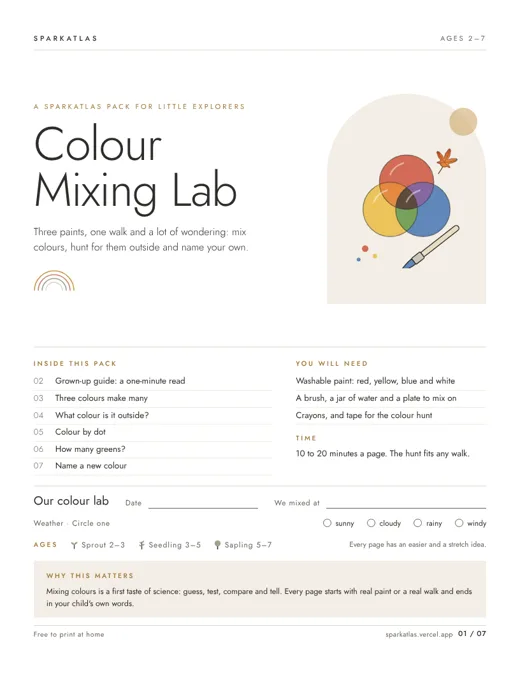
Children love to mix colours long before anyone explains it. This pack turns that urge into small experiments: guess what red and yellow will make, mix a little paint, dab it in the circle and compare it with the guess. A wrong guess is part of the fun.
Then the lab moves outside. Your child hunts for colours on a walk, matches real leaves to a home-made ladder of greens, and finds out why a blue jay looks blue and where autumn colours hide. The last page invites them to mix a colour nobody has seen before and give it a name.
Every page has an easier and a harder way in for ages 2 to 7. One shape code runs through the whole pack (a circle for red, a triangle for yellow, a square for blue), so it works printed in black and white, on Letter or A4.
What’s inside
- 1Cover: what's inside, what you'll need and a log for your colour lab
- 2Before you start: how to use it, three ways to play and safety notes
- 3Three colours make many: crayon circles that overlap, and a guess-then-paint test
- 4What colour is it outside? A colour hunt with tally circles and space to stick finds
- 5Colour by dot: a garden picture where shape-marks say which crayons to layer
- 6How many greens? Paint a ladder from light to dark, then match real leaves
- 7Name a new colour: mix it, paint it, name it and say what it looks like
Why this matters
Guessing before mixing is the heart of an experiment: your child predicts, tests and compares. Hunting and naming colours builds rich describing words, and ordering shades from light to dark is early maths in disguise.
Age bands
Every activity page has an easier and a stretchier way in, marked with these bands:
- Sprout 2–3
- Seedling 3–5
- Sapling 5–7
Letter is the standard paper size in North America; A4 is used almost everywhere else.