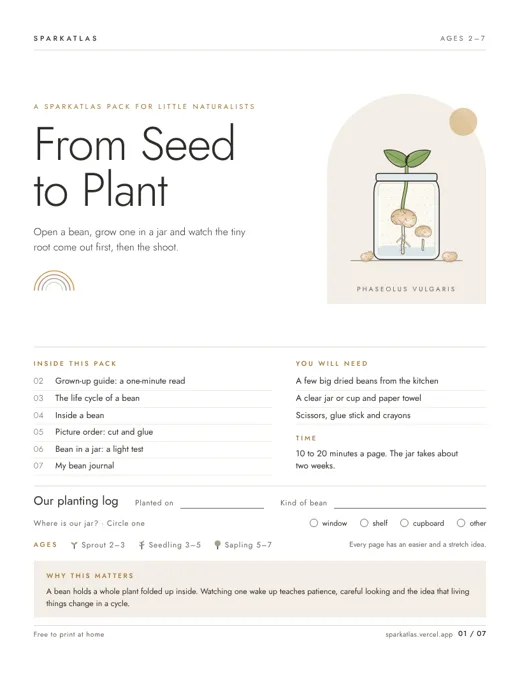
A dried bean from the kitchen holds a whole plant folded up inside. In this pack your child soaks one overnight, peels off the seed coat and opens it like a book to find the baby root, the two tiny leaves and the food store that keeps them going.
Then they grow their own. A clear jar lined with paper towel shows everything: the root pushes out first, then the shoot hooks up toward the light. Your child guesses whether a bean needs light to sprout, tests it with a jar in a bright spot and one in a dark cupboard, and keeps a journal of what changes, measuring with paper clips.
The life-cycle circle and the cut-and-glue picture strip tie it together, from seed to flowers to a pod full of new beans. Every page has an easier and a harder way in for ages 2 to 7, and the whole pack prints in black and white on Letter or A4.
What’s inside
- 1Cover: what's inside, what you'll need and a planting log
- 2Before you start: how to use it, three ways to play and safety notes
- 3The life cycle of a bean: five stages round a circle, from seed to new seeds
- 4Inside a bean: soak, peel and open a bean, then find its five parts
- 5Picture order: cut out five pictures and glue the bean's life in order
- 6Bean in a jar: set up a jar and test whether a bean needs light to sprout
- 7My bean journal: draw, tick and measure your bean every few days
Why this matters
Watching a seed wake up teaches patience and careful looking, and it makes an abstract idea real: living things change in a cycle. Guessing before testing turns a jar into a real experiment, and putting the stages in order builds the same sequencing skill children use to retell a story.
Age bands
Every activity page has an easier and a stretchier way in, marked with these bands:
- Sprout 2–3
- Seedling 3–5
- Sapling 5–7
Letter is the standard paper size in North America; A4 is used almost everywhere else.