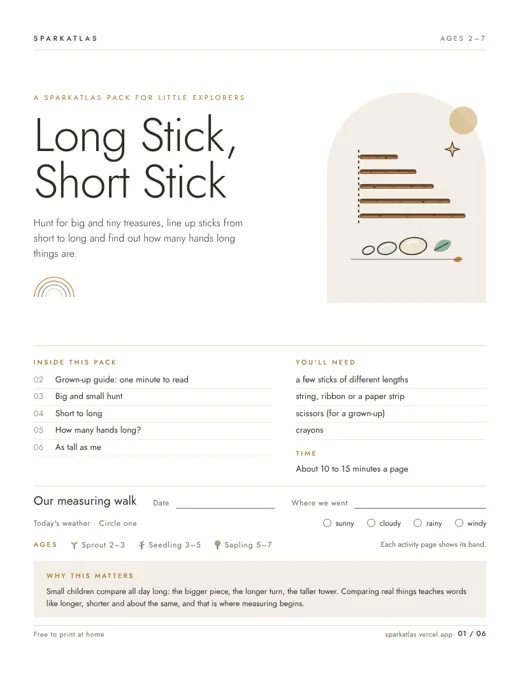
Small children measure long before they ever see a ruler. Who has the bigger piece, whose tower is taller, which stick is the longest for poking a puddle: comparing sizes is something they already care about, every day.
This pack takes that and heads outside. Children hunt for pairs (a big leaf and a tiny one, a tall tree and a tiny plant, a big puddle and a small one), then number five printed sticks from shortest to longest and lay their own sticks along a start line, which is the big idea behind fair measuring.
Then their own bodies become the ruler. They guess and count how many hands long a table, a box or a grown-up lying down is, compare their count with a grown-up's hands, and make a strip of string or paper as tall as themselves to find things taller, shorter and about the same. Every page has an easier and a stretch idea for ages 2 to 7, and it all prints on Letter or A4.
What’s inside
- 1Cover: what’s inside, what you’ll need and a measuring-walk log
- 2Before you start: how to use it, three ways to play and safety notes
- 3Big and small hunt: five pairs to find outside, plus your own pair
- 4Short to long: number five sticks, then line up real sticks from a start line
- 5How many hands long? Guess, measure and compare with a grown-up's hands
- 6As tall as me: make a strip as tall as you and draw what you find
Why this matters
Words like longer, shorter, taller and about the same are where measuring begins. Comparing real things, lining them up from the same start and counting hands with no gaps give young children the ideas behind every ruler, and a strip as tall as themselves turns growing into something they can see.
Age bands
Every activity page has an easier and a stretchier way in, marked with these bands:
- Sprout 2–3
- Seedling 3–5
- Sapling 5–7
Letter is the standard paper size in North America; A4 is used almost everywhere else.