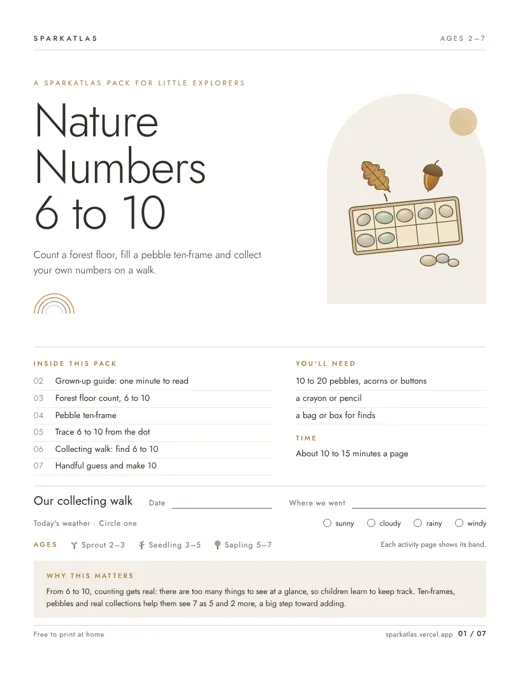
Once five is easy, the next numbers are where counting gets real: too many things to see at a glance, so children learn to keep track. This pack follows on from Nature Numbers 1 to 5 and keeps the pebbles, the pockets and the walks.
It starts on a busy forest floor of pinecones, leaves, pebbles, acorns and sticks, all mixed up, where your child crosses off each one as they count. Then comes a big ten-frame with spaces sized for real pebbles and six little challenges, from “put in 6” to “make 9 a new way”, plus big dashed numbers 6 to 10 to trace from a dot with a ring.
Outside, the collecting walk asks for 6 fallen leaves, 7 small sticks, 8 pebbles, 9 acorns or seeds and 10 pine needles or grass blades, with one dot to colour for every find. Back home, the handful page asks for a guess before every count and a few ten-frames to make 10. Each page has an easier and a stretch idea for ages 2 to 7, and it all prints on Letter or A4.
What’s inside
- 1Cover: what’s inside, what you’ll need and a collecting-walk log
- 2Before you start: how to use it, three ways to play and safety notes
- 3Forest floor count: cross off and count 6 to 10 scattered finds
- 4Pebble ten-frame: a big frame for real pebbles and six challenges
- 5Trace 6 to 10: big dashed numbers with a start dot and ten-frames
- 6Collecting walk: find 6 to 10 fallen treasures, plus a surprise find
- 7Handful guess: guess, count, more than 10, and make 10
Why this matters
From 6 to 10, children stop seeing amounts at a glance and start keeping track. Ten-frames and real pebbles help them see 7 as 5 and 2 more, which is the start of adding in their heads. Guessing before counting builds the same habit scientists use: predict, then check.
Age bands
Every activity page has an easier and a stretchier way in, marked with these bands:
- Sprout 2–3
- Seedling 3–5
- Sapling 5–7
Letter is the standard paper size in North America; A4 is used almost everywhere else.