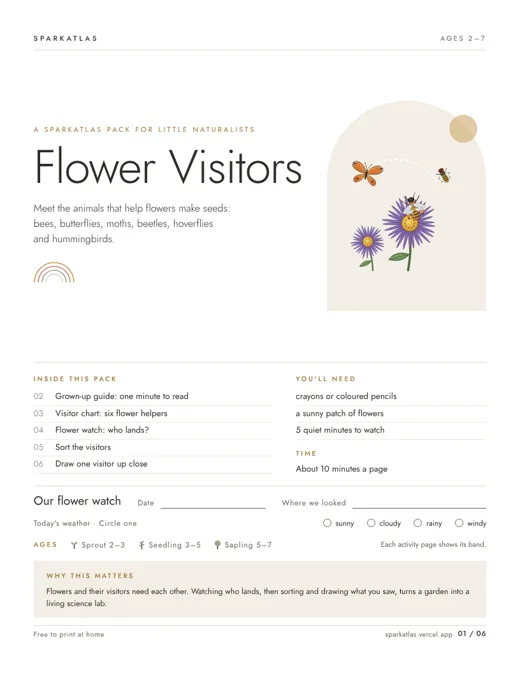
Flowers and their visitors need each other. This pack opens with a labelled chart of six helpers: honey bee, butterfly, moth, hoverfly, beetle and hummingbird (where it lives), plus a blank space for a visitor your child finds.
A short flower watch asks you to guess who will land most, then tally bees, butterflies, hoverflies, beetles and anything else for five quiet minutes. A day-or-night sort groups the same visitors, with soft notes about moths that fly by day and bees that start early.
The last page is a field-journal drawing: one visitor big, one tiny part up close, and talk lines underneath. Every page has an easier and a stretch idea for ages 2 to 7, and the whole pack prints on Letter or A4.
What’s inside
- 1Cover: what’s inside, what you’ll need and a flower-watch log
- 2Before you watch: how to use it, three ways to play and safety notes
- 3Flower helpers: tick six labelled visitors and draw your own
- 4Flower watch: guess, tally who lands, and draw one visitor
- 5Day or night: sort the visitors, then notice soft exceptions
- 6My visitor page: draw one helper big and one tiny part
Why this matters
Watching who lands on a flower, then sorting and drawing what you saw, turns a garden into a living science lab. Children practise careful looking, early counting and putting living things into groups.
Age bands
Every activity page has an easier and a stretchier way in, marked with these bands:
- Sprout 2–3
- Seedling 3–5
- Sapling 5–7
Letter is the standard paper size in North America; A4 is used almost everywhere else.