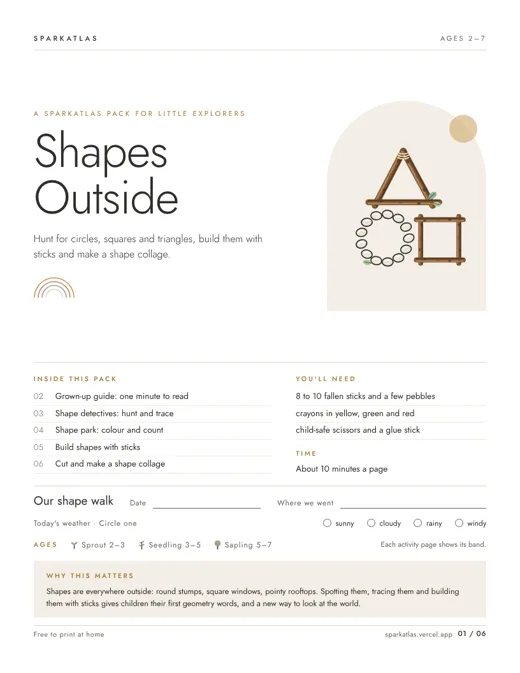
Once a child learns to spot a circle, the world fills up with them: a tree stump, a wheel, the middle of a flower. This pack takes the three first shapes, circle, square and triangle, out of the book and into the park, where children trace them, hunt for them and build them with their own hands.
Your child traces each big shape from a starting dot, then hunts for stumps, windows and rooftops on a walk. Back home, a little park made only of shapes waits to be coloured and counted. Then fallen sticks and pebbles become a triangle, a square and a ring, with sides and corners to count. To finish, cut-out shapes turn into a house, a tree, a boat or something nobody expected.
The youngest trace with a finger, look for circles and tear paper shapes to glue anywhere. Older children count sides and corners, find the hidden rectangles and plan their own collage. Every page has an easier way in and a stretch, so siblings can hunt together.
What’s inside
- 1Cover: what's inside and a field log for your shape walk
- 2Before you go shape hunting: a one-page guide for grown-ups
- 3Shape detectives: trace each shape and tick what you find
- 4Shape park: colour every shape and count each kind
- 5Build shapes with sticks: count the sticks and corners
- 6Make a shape collage: cut out shapes and turn them into a picture
Why this matters
Children learn shapes best with their eyes, fingers and whole bodies. Tracing a shape, finding it in a stump or a rooftop and building it from sticks shows what makes it a triangle or a square: the number of sides and corners. These are the first words of geometry. Real things are rarely perfect shapes, so a slice of orange counts as a circle. Your child sets the pace.
Age bands
Every activity page has an easier and a stretchier way in, marked with these bands:
- Sprout 2–3
- Seedling 3–5
- Sapling 5–7
Letter is the standard paper size in North America; A4 is used almost everywhere else.