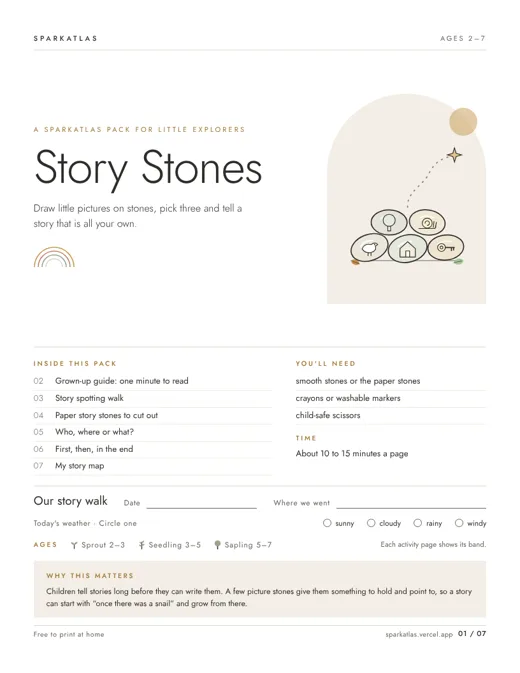
Children tell stories long before they can write them. Give them a few smooth stones with simple pictures — a bird, a house, a key — and a story has something to start from: “once there was a snail who lost a key…”
The pack begins outside, on a walk to spot things that could be in a story: a bird, a big tree, a puddle, a feather, a door, a funny cloud. Back home there are twelve paper story stones to cut out and four blank ones to draw, or you can copy the pictures onto real pebbles with crayon or washable marker.
Then children sort the pictures into who, where and what (a tree can talk in a story, so there is no single right tick), pick three stones and tell what happens first, then and in the end, and draw their story as places along a winding path. Each page has an easier and a stretch idea for ages 2 to 7, and it all prints on Letter or A4.
What’s inside
- 1Cover: what’s inside, what you’ll need and a story-walk log
- 2Before you start: how to use it, three ways to play and safety notes
- 3Story spotting walk: find things outside that could be in a story
- 4Paper story stones: twelve picture stones to cut out and four to draw
- 5Who, where or what: decide what each picture could be in a story
- 6First, then, in the end: pick three stones and tell a three-part story
- 7My story map: draw the places your character visits along a path
Why this matters
Telling a story out loud builds the same skills children later need for reading and writing: putting events in order, choosing words and keeping a listener in mind. A stone in the hand makes it easier to begin, and a grown-up who asks “what happened next?” keeps the story growing.
Age bands
Every activity page has an easier and a stretchier way in, marked with these bands:
- Sprout 2–3
- Seedling 3–5
- Sapling 5–7
Letter is the standard paper size in North America; A4 is used almost everywhere else.