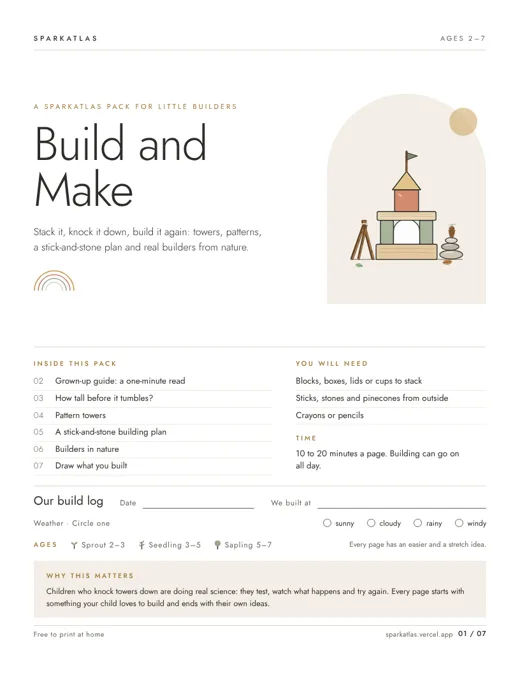
Little children build all day: blocks, boxes, cushions, a line of stones on the path. This pack takes that building seriously. Your child guesses how many blocks they can stack, builds until the tower tumbles, counts, then changes one thing and tries again. Knocking it down is allowed, and it's part of the science.
Then the building moves outside. Your child draws a plan, gathers sticks, stones and pinecones, builds something that stands on its own and compares it with the plan. Along the way they meet four real builders from nature: a beaver, a robin, a paper wasp and a young caddisfly, each with a trick small hands can copy.
Every page has an easier and a harder way in for ages 2 to 7. The pattern towers use plain, dotted and striped blocks rather than colours, so the whole pack works printed in black and white, on Letter or A4.
What’s inside
- 1Cover: what's inside, what you'll need and a build log
- 2Before you start: how to use it, three ways to play and safety notes
- 3How tall before it tumbles? Guess, stack, count and compare three tries
- 4Pattern towers: finish four block patterns, invent your own and build them for real
- 5Stick-and-stone building plan: plan it, gather it, build it and compare
- 6Builders in nature: a beaver, a robin, a paper wasp and a caddisfly, plus a builders' hunt
- 7Draw what you built: an engineer's journal page for your best build
Why this matters
Children who knock towers down are doing real science: they guess, test, watch what happens and try again. Continuing patterns is early maths, planning and comparing is how engineers work, and drawing a build afterwards turns play into memory and new words.
Age bands
Every activity page has an easier and a stretchier way in, marked with these bands:
- Sprout 2–3
- Seedling 3–5
- Sapling 5–7
Letter is the standard paper size in North America; A4 is used almost everywhere else.