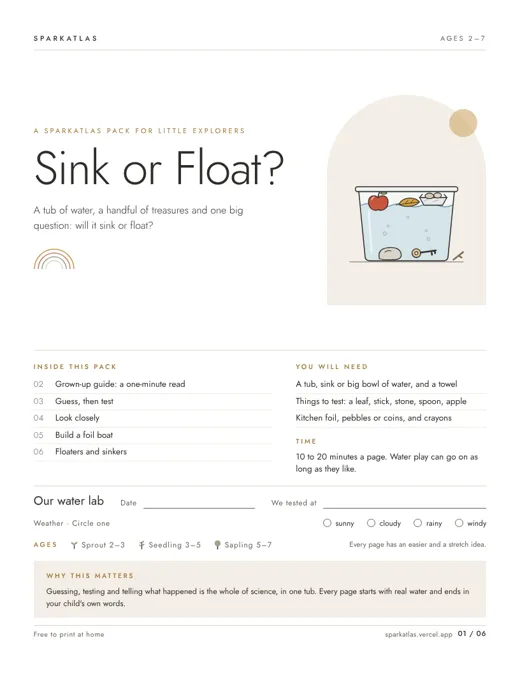
Fill a tub, a sink or a big bowl with water, gather a basket of things from the house and garden, and ask the oldest science question there is: will it sink or float? Your child guesses first, then drops each thing in and ticks what really happened.
Then they look closer. One floater and one sinker go side by side on paper, drawn big and then up close, with words for how they feel. After that it's time to build: a square of kitchen foil becomes a boat, and your child adds pebbles one at a time to see how much it can carry before it goes under.
The last page sorts everything into floaters and sinkers, then tries to change the result with a ball of play dough and an orange with and without its peel. Every page has an easier and a harder way in for ages 2 to 7, and the whole pack prints in black and white on Letter or A4.
What’s inside
- 1Cover: what's inside, what you'll need and a lab log
- 2Before you start: how to use it, three ways to play and safety notes
- 3Guess, then test: tick a guess and a result for eight things and two of your own
- 4Look closely: draw a floater and a sinker, then a tiny part up close
- 5Build a foil boat: make two boats and count the pebbles each one carries
- 6Floaters and sinkers: sort what you tested, then try to change the result
Why this matters
Guessing, testing and saying what happened is the whole of science, and a tub of water makes it something a toddler can do. A wrong guess becomes a discovery instead of a mistake, and counting pebbles in a foil boat turns a splashy game into a fair test.
Age bands
Every activity page has an easier and a stretchier way in, marked with these bands:
- Sprout 2–3
- Seedling 3–5
- Sapling 5–7
Letter is the standard paper size in North America; A4 is used almost everywhere else.