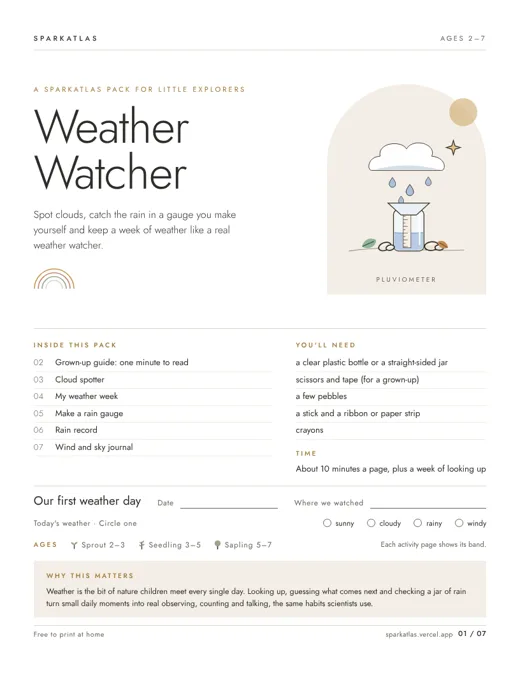
Every child has an opinion about the weather. Is it a puddle day or a sledding day? Do we need boots? This pack takes that everyday interest and turns it into a week of real weather watching. It opens with a cloud chart in the style of an old field guide: puffy cumulus, a low grey blanket of stratus, wispy cirrus high up and a towering cumulonimbus, each with what its Latin name means and a box to tick when you spot it.
Then you make a real tool together. A grown-up cuts the top off a clear bottle, it goes back in upside down as a funnel, and children tape on the true-size centimetre strip printed on the page. The gauge stands outside in an open spot, and for the next seven days children check it at the same time each day, colour a jar on the rain record up to the water line and empty the gauge. On snowy days they bring it in and watch a jar of snow melt into a surprisingly small amount of water.
Alongside the gauge, a weather week chart has one tick row each for sunny, cloudy, rainy, windy, snowy and foggy, a box for drawing what they wore and a colour-a-square count to see which weather won. The last page is a wind and sky journal: tie a ribbon to a stick and see whether it hangs, flutters or flies straight out, draw the sky, and say what you can hear, feel and smell. Every page has an easier and a stretch idea for ages 2 to 7, and it all prints on Letter or A4.
What’s inside
- 1Cover: what’s inside, what you’ll need and a first weather day log
- 2Before you start: a week plan, three ways to play and weather safety
- 3Cloud spotter: cumulus, stratus, cirrus and cumulonimbus, plus cloud shapes
- 4My weather week: tick the weather, draw what you wore, count the week
- 5Make a rain gauge: five steps, a true-size centimetre strip and your guess
- 6Rain record: colour seven jars, find the wettest and driest day
- 7Wind and sky journal: ribbon wand test, draw the sky, use your senses
Why this matters
Weather is the one part of nature children meet every single day, so it is a perfect first science. Looking up, guessing what comes next, building a tool and checking it at the same time each day are the habits real scientists use, and a week of ticks and coloured jars becomes your child’s first chart, made from their own sky.
Age bands
Every activity page has an easier and a stretchier way in, marked with these bands:
- Sprout 2–3
- Seedling 3–5
- Sapling 5–7
Letter is the standard paper size in North America; A4 is used almost everywhere else.